Are you pressed for time, stuck in a hotel room, or overburdened with meetings? No excuses, no gym, no equipment. You have the most fantastic exercise equipment, and with the correct exercises, you can increase your strength, stamina, and fitness level anywhere.
As a personal trainer, I help people maintain consistency, whether they’re in living rooms, airport gates, or hotel lobbies. I’ve designed popular bodyweight workouts that deliver results. Best of all, they don’t need costly equipment.
In this post, I’ll list the five valuable exercises you can perform anywhere. These exercises will help you stay strong, mobile, and on track whether you have 30 minutes or only five.
Why Bodyweight Training Works
Don’t believe that you need a gym to get stronger. Bodyweight training develops functional fitness that improves real-world movement, rather than just gym performance.
You can train muscles to work together during mobility, balance, and coordination training. Doing so is especially valuable when pushing, pulling, squatting, or lunging with body weight. ACE Fitness supports bodyweight exercises because they mimic our daily movements. They believe these exercises are key to improving movement quality.
Bodyweight training engages stabilizers, increases flexibility, and strengthens the core in one process, unlike machine-based gym workouts that isolate muscles with fixed movements.
There are no barriers to entry, excuses, or membership fees, and you don’t need to drive through the traffic to get there.
You can work out your entire body without any equipment, whether in a hotel room, a park, or a small studio apartment. If you can’t get to the gym, that’s no excuse. You can train anywhere—whether in a hotel room, a park, or a small studio apartment.
Whether you’re a busy parent or a CEO, having a plan for consistency is more important than a perfect setup. With bodyweight training, you can always fit in the best exercises—no barriers, no excuses.
And if you’re concerned about advancement, progressive overload enters the picture. To make things more challenging without dumbbells, increase the range of motion, add isometric holds, slow down repetitions, or move to more complex variations like pistol squats or archer push-ups.
You have complete control over the level of intensity. Research by the National Strength and Conditioning Association (NSCA) shows practical bodyweight exercises boost muscle activation and endurance better than traditional strength training.
No weights? No problem. Consistency, creativity, and recognising that your body is the best tool you have are key.
Exercise #1: Push-Up Variations
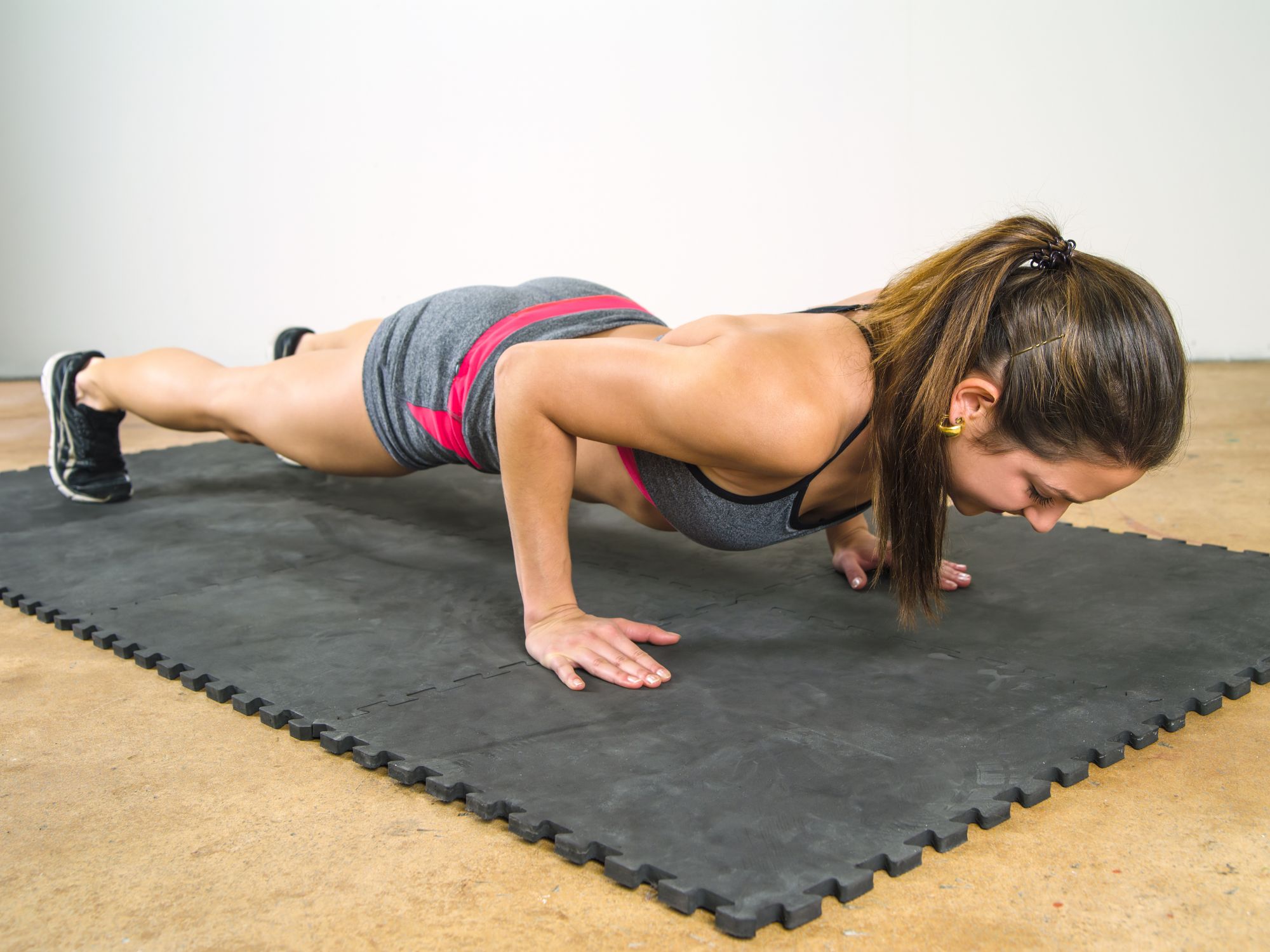
The push-up is the ultimate powerhouse move without any equipment. It’s key to any bodyweight routine because it works your core, triceps, shoulders, and chest.
Many people miss the full benefits because they rush and use lousy forms. Focus on mastering proper push-up techniques to boost strength and prevent shoulder or wrist strain. This is important for everyone, no matter your skill level.
Progressing from Beginner to Beast
Have you never done a push-up before? Start with incline push-ups to lessen resistance, and place your hands on a stable surface, such as a bench or countertop. Knee push-ups are a great way to boost upper-body endurance. This technique helps you build strength while being easy on your joints.
Do you know the fundamentals? Concentrate on performing standard push-ups using a full range of motion and controlled movement, lowering your chest and exerting strength to push it back up.
Are you seeking a challenge? Try clapping push-ups for explosive power. You can also do diamond push-ups with hands close together to work your triceps. If you want a challenge, try one-arm push-ups to test your balance and core.
Form is Everything
Proper form enhances appearance, maximizes performance, and reduces the risk of injury. Remember these cues:
- Keep your elbows at 45 degrees; you’ll strain your shoulders by overextending them.
- Use your core; visualize your body as a straight line that extends from your head to your heels.
- Regulate the motion: Lower carefully, then apply firm pressure to push up. No drooping hips or protruding butts!
Pro Tip: Make it Work for Your Schedule
As a mobile personal trainer, I see clients struggle to fit exercise into their busy lives. My ploy?
- Do intervals of push-ups.
- Try to fit 10 repetitions before showering, between work calls, or during a TV commercial break.
- Do you want to move up the difficulty ladder? Slow down the descent (eccentric phase) to increase strength using less volume.
Exercise #2: Squats & Split Squats
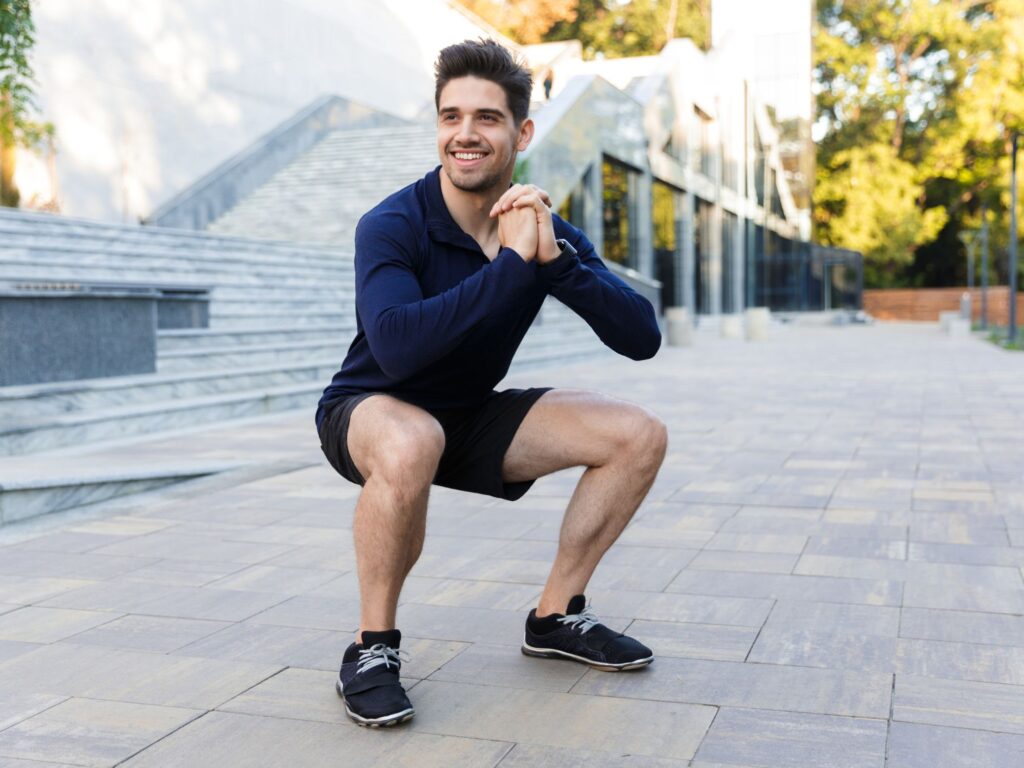
The squat is an exercise that should be part of every workout, whether in a gym or a cramped hotel room.
Squats train the movement patterns we use daily, so they’re not for building strong legs. When you leave a chair or climb stairs, your quads, hamstrings, and glutes do the heavy lifting. For this reason, regardless of how little time or space my clients have, I always include squats in their routines.
Mastering the Basic Bodyweight Squat
Isn’t the squat beautiful in its simplicity? To define the stance, you can stand with your feet shoulder-width apart and minutely turn your toes outward.
Picture sitting in an invisible chair as you go down. Your knees should stay over your toes and not bend in. Push your hips back and keep your chest up. Drive through your heels to stand after attempting to lower yourself until your thighs are at least parallel to the floor.
This exercise works your whole lower body. It’s easy, even in a small hotel room or Airbnb.
Bulgarian Split Squat: A Unilateral Challenge
When I train, I often search for commonplace items to elevate my clients’ workouts.
You can do the Bulgarian split squat with a chair, hotel bed, or sturdy suitcase. Test your balance and isolate each leg by putting one foot behind you and lowering into a deep lunge. Anyone who wants to increase intensity without using weights or dealing with muscle imbalances will find this especially helpful.
Adaptations for Every Level
Beginners can focus on slow, deliberate movements using a chair or a wall for support. If bodyweight squats feel easy, try a Bulgarian split squat. You can also slow down the lowering phase: take three seconds to go down and one second to come up.
Advanced athletes can turn leg day into a cardio workout by adding jump squats or explosive split lunges for an added burn. Squats and split squats are essential. I use them when coaching clients in a tiny NYC apartment or helping someone squeeze in a quick workout during a layover. They don’t need equipment. A bit of space and motivation will do to boost strength and mobility.
Exercise #3: Planks & Plank Variations
The plank is my choice for a core exercise that yields the best results without equipment.
Planks are the best workout for any location and moment, whether waiting in an airport lounge, in a hotel room, or transitioning between Zoom calls. They build your core, including your shoulders, lower back, and obliques, and help shape your abs.
A strong core looks good, but it also helps with posture. It prevents lower back pain and boosts performance in running and lifting groceries.
Plank Variations for Every Level
Planks are great for everyone because they are so versatile.
If you’re new to the exercise, start with a forearm plank, keeping your knees on the floor if needed. If you want to be more seasoned, add shoulder taps, which involve switching hands to touch opposing shoulders without allowing your hips to sway, to a high plank (on your hands).
Or, do you need something more sophisticated? Plank walk-ups, where you switch between forearm and high plank, can boost the challenge. Side plank twists and alternating leg lifts can also be used.
Again Form Matters More Than Time
A minute-long plank will not do much with poor form. Avoid sagging hips or a raised rear end, maintain a straight line from your heels to your head, and contract your abs. Don’t hold your breath, please. Breathe.
Planks Fit into Any Schedule
One of my go-to tips for clients with hectic schedules? The plank works. During work breaks or layovers, spend 30 to 60 seconds on a plank instead of scrolling through your phone without purpose. This habit develops incredible core endurance over time with minimal effort.
Exercise #4: Glute Bridges
The glutes are the powerhouses of your lower body. Strong glutes look good and provide proper support to your lower back, stabilize your hips, and extend your range of movement.
However, sitting at a desk, driving, or flying can weaken your glutes, leading to tight hip flexors and lower back pain. For this reason, I always incorporate glute bridges into my clients’ routines. This effortless yet effective exercise without special equipment improves posture and reactivates dormant muscles.
How to Perform Glute Bridges
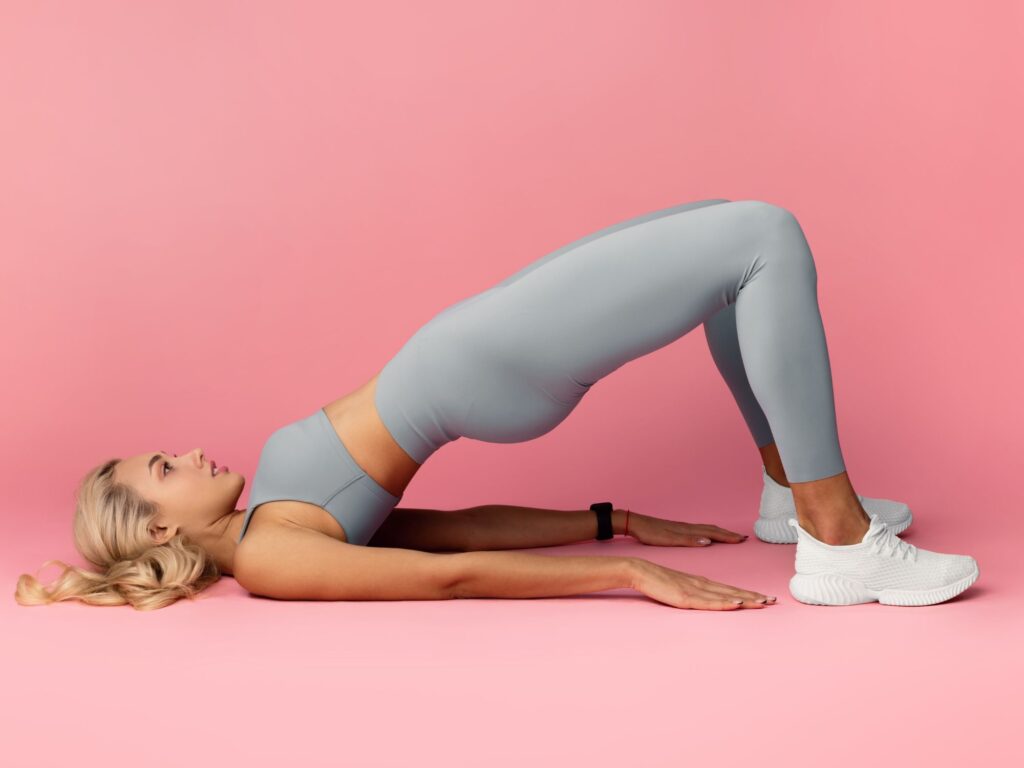
- Place your feet slightly apart at hip width and bend your knees with your back flat on the floor.
- Raise your hips toward the ceiling while squeezing your glutes and pushing through your heels.
- Make a straight line from your shoulders to your knees at the summit.
- After a brief pause and glute contraction, slowly return to the starting position.
Progressions for Every Fitness Level
- Beginner: Start with a standard two-legged bridge. Extend your hips completely before lowering.
- Intermediate: Press up with one leg while extending the other straight to try a single-leg glute bridge.
- Advanced: Alternate leg lifts while maintaining an elevated hip position or introduces a marching glute bridge. Pause for a few seconds at the top.
My On-the-Road Trick
I often advise clients to perform elevated glute bridges while traveling, utilizing a park bench, a sturdy chair, or even their hotel bed. It improves the exercise’s effectiveness by expanding the range of motion. This variation is excellent for building your posterior chain. It also helps stretch tight hip flexors, especially after long hours in a plane seat.
Performing glute bridges can significantly improve the strength and mobility of your lower body. You can do them at home, in a hotel, or even during a quick break at work. So, no excuses—get those hips up and activate those glutes!
Exercise #5: Mountain Climbers – The Full-Body Finisher
Mountain climbers provide an ideal workout for both your core and heart. I have coached many clients, from weekend warriors to busy parents and travelers, on adding bodyweight training to their routines. Mountain climbers are always a favorite.
They burn calories quickly, involve the entire body in a single fluid motion, and do not require special equipment.
Why Mountain Climbers Work
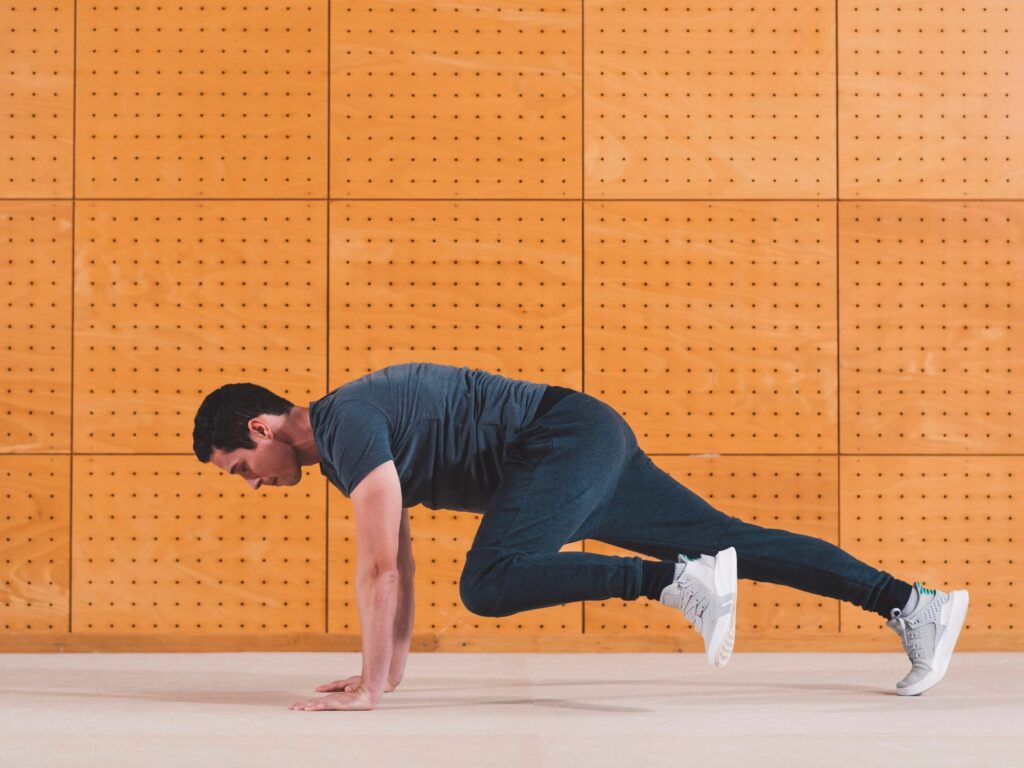
This dynamic exercise blends the fast-paced intensity of a sprint with the core activation of a plank. Afterward, your legs engage your abs, obliques, and hip flexors. Meanwhile, your shoulders, arms, and chest stay in a strong plank position. The fast movement also raises your heart rate, making it an excellent exercise for increasing endurance and burning fat.
High-intensity bodyweight exercises like mountain climbing boost anaerobic and aerobic capacity, making them a great addition to any fitness program (American Council on Exercise).
FORM MATTERS—Here’s How to Do Them Right
- Start in the high plank position, placing your hands directly beneath your shoulders, engaging your core for support, and keeping your back flat.
- Switch your legs rapidly after driving your right knee toward your chest.
- Avoid sagging or picking up by keeping your hips level.
- Keep your pace steady and make sure every knee drive is deliberate.
Make Body Weight Exercises Work for You
- Beginner: Take time and concentrate on using your core during each exercise.
- Intermediate: Create a steady rhythm by accelerating a little.
- Advanced: Try cross-body mountain climbers (knee to opposite elbow) or incorporate a small jump for an intense challenge.
My Favorite Finisher
To challenge my clients even more, I enjoy concluding workouts with mountain climbers. My preferred finisher? Work hard for 30 seconds and rest for 15 seconds, repeating this 3–5 times. It’s a brief, intense workout that gives you a sense of accomplishment. This is a good workout if you’re pressed for time but want to see results!
Fitting Resistance Training Exercises into a Busy Schedule
We’ve all been there: trying to keep fit while meeting obligations to our families, friends, and coworkers and traveling.
“I just don’t have the time” is the usual excuse I hear as a constantly on-the-go personal trainer. The fact is that resistance training doesn’t have to mean expensive equipment and a lengthy gym session.
With your body weight, you can build strength, boost endurance, and feel more energized in 15 minutes.
The 15-Minute Anywhere Routine
Here is a quick and efficient bodyweight exercise that works all the major muscle groups for people with limited time:
- Classic, wide-arm, or diamond push-ups can work on different muscle groups (45 seconds on, 15 seconds off).
- Squats, or Bulgarian split squats, are performed 45 seconds on and 15 seconds off. They are great exercises for strengthening and balancing the lower body.
- A plank or plank variation engages the core for 45 seconds on and 15 seconds off. It also includes side planks, forearm planks, or plank reaches.
- Glute bridges only take 45 seconds to activate the posterior chain, which is easier to do when you spend a lot of time sitting.
- Mountain Climbers are intense exercises that raise the heart rate while engaging the core (45 sec on, 15 sec off).
- Take a minute to rest after completing one round, and then, if time permits, repeat 1 or 2 more times.
These brief, high-intensity circuits help you stay productive and on course.
The “No Excuses” Mindset
Divide the fifteen minutes into smaller segments if you cannot simultaneously divide them. I advise my busiest clients to consider movement like hydration: tiny doses spread out throughout the day have a significant impact. Try this:
- To relieve stiffness, perform squats or desk push-ups once an hour.
- Go for a plank challenge to pass the time while your coffee brews.
- Raise the calf while brushing your teeth.
Movement adds up. With five minutes spent here and five minutes spent there, you can build a routine without disrupting your day.
Set Goals, Track Progress, Stay Consistent
It’s essential to ignore the urge to make it perfect and work instead on the progression. Check for how long you can hold a plank or the maximum number of push-ups within 45 seconds. Little victories give you momentum and confidence. And never forget that it’s always better to show up than to do nothing, even in tiny ways.
Final Thoughts: Own Your Workout, Anywhere
Do you find going to the gym boring? Bodyweight exercise is one of the most effective means to acquire strength, endurance, and mobility that one can adapt to daily routines. You can move about anywhere, in your living room, in a hotel room, or even in an airport lounge.
I have trained just about every kind of client, and one thing that stands out from this experience is that the most significant barrier to reaching your goals is not equipment but initiative. So here is your challenge: choose one of these workouts and commit to doing it for a week, every day.
You must spot your feelings, understand your strengths, and take this opportunity. Life does run fast; however, fitness is something that you should not compromise on. A few minutes can really change the game with a focused exercise routine.
Do you have inquiries? Please post them in the comments section. Are you prepared for more fitness advice that you can use while on the go? Let’s keep going, no excuses, and follow me on social media.